lillibet: (Default)
How did you celebrate your 30th birthday?

I had a wonderful, wonderful birthday that year.

I was living in Berkeley, working for Katie Hall at Laurel Management in San Francisco. Jason and I had been dating for over a year, but he was still living in Sunnyvale. My actual birthday was on Friday, but the celebration was spread over several days.

On Wednesday night Jason and a couple of friends from the Foothill Conservatory theatre program joined me to see Berkeley Rep’s production of Shakespeare’s Antony and Cleopatra. It was marvelous. One of the best Shakespearean productions I’ve ever seen. It was very stylized, but in a way that suggested “stripped down to the text” rather than a superimposed vision. There were only seven people in the cast and they did an amazing job of switching between characters. Both voice and movement were incredibly polished and beautiful and the lighting, in particular, was stunning. More than twenty years later I still remember the bare stage defined by a giant hawser of rope that the cast hauled about the stage to evoke different settings.

On Thursday night Jason and I went to the Oakland Arena for Stars on Ice, the professional skating show featuring Scott Hamilton, Kristi Yamaguchi, Tara Lipinski and Ilia Kulik. It was lots of fun and had a number of very original performances, playing with black light and blade mics, mixing and matching the pairs and singles skaters in interesting ways.

On Friday at work, Katie decided that since it was my birthday that day and Lycia Carmody’s the next, the company should buy lunch for everyone. So we had yummy Chinese food and they brought out a cake for each of us: carrot with cream cheese frosting for me and angel food with whipped cream and berries—both of which I happen to love. Then I went home to clean and cook and Tom Wethern—in town from Boston on a business trip—came over to hang out with me for a few hours.

On Saturday I got a package from Beckie with a videotape of Impromptu, one of my favorite movies, and a letter from my parents that was so sweet and supportive that I called to thank them and chat for a while. Anne and George were travelling in India at the time.

That evening was my birthday party. Jason was the first to arrive, followed by Rob Harris and Susan Lippincott. We played a couple of hands of four-way cribbage and then Bob Kindall &
Jessie Stickgold-Sarah arrived and that was critical mass, so we moved into the living room as people continued to arrive. About thirty more people showed up over the course of the evening. We drank wine and ate cheese and fruit and salami and veggies and artichoke dip and brownies.

I got some wonderful presents:

• Eric Rescorla brought me _A Beautiful Mind_, the biography of John Nash.

• Robert replaced the recording walkman that got stolen last year, so I could go back to recording books onto tape for
him.

• Jason gave me a cordless hand mixer and brought me a lovely little shell-shaped box from his mother.

• Lindasusan Ulrich and Alicia Bell gave me an IOU for the new cook book by the editor of Cooks Illustrated and a beautiful blue bottle of almond oil and Linda’s housemate, Laura, brought me vegetable soap.

• My housemate, Beth Dart, gave me a funky paint-your-own china kit.

• Linda Branagan, John Sweet & WesCarroll gave me a box with a Year of the Rooster pendant, a mango spice candle and stationery. Wes said later he thought of giving me invitations, but decided that would be too blatant. He also gave me possibly the nicest card I have ever received. The front had an Emerson quote: “What is success? To laugh often and much; to win the respect of intelligent people and the affection of children; to earn the appreciation of honest critics and endure the betrayal of false friends; to appreciate the beauty; to find the best in others; to leave the world a bit better, whether by a healthy child, a garden patch Or a redeemed social condition; to know even one life has breathed easier because you have lived. This is to have succeeded!” and inside Wes wrote “Yup, that’d be my friend Elizabeth.”

Steve Gisselbrecht called around nine and let Linda Marie Sauter, Jonathan Root, Jeff Fabijanic, and Tom (now back home in Boston) say Happy Birthday to me. That was really cool. Generally, the whole event made me feel very aware of how many people there really are out here who care enough
to come to a party and to think of me fondly, even from far away.

The last hour of the party involved a huge game of Star Wars Trivial Pursuit, which was very close, but Jason and I won. Dave La Macchia was peeved that I wouldn’t let them open the ten Episode One cards included with the deck, for fear of spoilers, since the movie wouldn’t open until May. The last guest left

around 3:30am, after which Jason and I lay in bed and laughed at each other for an hour before falling asleep.

We had a quiet Sunday together, making grilled cheese sandwiches with Scottish cheddar and watching Impromptu. And then he headed home and I cleaned up and that was how I celebrated turning 30.
lillibet: (Default)
What are your favorite plays?

In general, my favorite plays are very wordy and witty, with the humor arising from the cleverness of the lines. I enjoy creative staging—not necessarily spectacle—and engaging characters are a must. I tend to prefer comedies, or dramas with a good balance of humor, to serious dramas, mostly because I hate to see people making stupid choices, or being mean to one another, but some of my favorites are not comedies and I don’t generally like broad humor. I like a happy ending and a clear statement of purpose. Perhaps unsurprisingly, many of my favorites are shows that I’ve directed.

Possibly my favorite show of all time is Mary Zimmerman’s “Metamorphoses”. I first saw it at Berkeley Rep in 1999 and it haunted me for years. I saw a student production at Harvard in 2007, which rekindled my dream of directing it with Theatre@First, but it was not until I saw a revival at Arena Stage in Washington, DC in 2013 that I began to really pursue that dream. The biggest challenge is that the show was conceived to be staged in and around a large, shallow pool of water—not something feasible in any of the spaces Theatre@First regularly uses. I began to think that the water could be represented by fabric and from there was able to come up with a dry staging that still makes me very proud. 

The play is a set of Greek myths excerpted from Ovid and woven together to create a lyrical exploration of love and its positive and negative expressions. To quote a review of the Berkeley Rep revival in 2019, “‘Metamorphoses’ has a breathtaking aesthetic, with beauty, grace, poetry, and humor. It is a rare and unforgettable theatrical experience that should not be missed.” Even as a director, I was unable to watch a run of the show without laughing out loud and weeping quietly. That kind of connection, on the emotional, intellectual, and aesthetic levels, is a rare joy.

Another of the plays I first saw at Berkeley Rep and later brought to Theatre@First is Lillian Groag’s sadly overlooked play, “The Magic Fire”. A lyrical tapestry of history, memory, and music, the play tells the story of one family’s decision to leave Argentina as fascism overtook their country. When I proposed the play I was mostly interested in the main character, presented simultaneously at age 8 (though we stretched it to 10 so that Alice could play the role) and 30, sorting through her memories of a confusing, tumultuous time. But by the time we staged it in 2017 it had become sadly relevant. Looking back at photos of that production makes me proud and wistful for a show that in many ways could only have worked the way that it did just at that moment in time, which seems fitting for the play itself.


My favorite Shakespearean play is “Much Ado About Nothing”. It includes one of my all-time favorite couples—Beatrice and Benedick—and uses some of the same plot twists as “Romeo and Juliet” to a much more satisfying conclusion. I love the language and the festive nature of the show and the questions of appearances and disguise that run throughout the script. Directing the show in 2008 is one of my favorite memories from the early years of Theatre@First. 

One of my favorites that I have not yet had the opportunity to direct is “The Importance of Being Earnest”. That one makes me giggle no matter how many times I’ve heard its jokes. It is overly long and somewhat over-complicated, but in the right hands it is a charming trifle with profound undertones that miraculously transcends the very specific nature of its setting and targets. I can’t decide if I’m more interested in directing it, or in playing Lady Bracknell, but either way I hope someday to do it.

I was very surprised to find that I love “Noises Off”. I am not usually a fan of broad farce and this is one of the broadest. The way that playwright Michael Frayn builds his gags from plausible to over-the-top absurdity is genius and the backstage drama is hilarious from start to finish. When Jason and I saw it in London, a critic’s verdict “Life threateningly funny!” hung from the marquee outside and Jason commented that it seemed excessive, particularly for a British reviewer. At one point during the show (I believe it was the cactus-needle extraction bit) Jason was laughing so hard that he curled up in his seat beside me and I was pounding on his back like a table as I guffawed. Once the moment had passed, I whispered an apology. “Sorry about that.” “About what?” “For hitting you!” “You hit me?” We agreed that dying of laughter was well within the risks of that show.

Even more surprising is that the same playwright, Michael Frayn, wrote “Copenhagen,” a beautiful puzzle box of a show about Heisenberg’s uncertainty principle. It’s a very serious three-hander about an unknowable conversation between Heisenberg and Niels Bohr during World War II. With the right actors in the roles what could be a dry philosophical debate becomes a gripping, passionately intellectual wrestling match for the soul of a great mind. That the ending is uncertain without leaving the audience unsatisfied is a triumph of playwrighting.

Another candidate for my favorite play is Tom Stoppard’s “Rosencrantz and Guildenstern Are Dead,” which I’ve now directed twice. The playfulness of the script is a joy and the existential comedy appeals to my sense of humor. No matter how many times I see it, or read it, I always find something new, and directing it has taught me a great deal of what I know about that process. I’m also deeply fond of his “Arcadia,” though I find it harder to communicate to an audience, but I hope someday to direct that, as well. Stoppard’s essential thesis, that history and meaning are unknowable to those who come after, is very attractive to me and a thread I enjoy tracking through all of his work. 

One of the most personally resonant plays for me is “The Margaret Ghost,” by Carole Braverman, based on the life of Margaret Fuller. I first saw it performed at Radcliff in 1985, when a friend of my sister was stage managing. For a sixteen year old girl, the story of a woman who was too smart to be attractive to the men of her milieu, yet finds love and makes her mark on history, was deeply moving and inspiring. Twenty years later, having recently founded a theatre company of my own, I was able to track down the playwright and the never-published script and had the joy of bringing it to audiences not once, but twice, as we were invited to revive our 2006 production in 2010 for the bicentennial of Fuller’s birth. The characters and language are fantastic and the arguments over how to live fully as a woman are still gripping today. During the pandemic the cast reunited to do an online reading and I found myself enchanted by it once more and wishing that it could find a wider audience. 

Looking back at this list, what ties them together for me is the theme of self-awareness and the struggle to figure out the purpose and pattern of one's life. Having the opportunity to live within them, teasing out their nuances and determining the meanings that matter most, is both a pleasure and a source of many of my most treasured memories. The play really is the thing!
lillibet: (Default)
What was the best job you've ever had?

The best job I ever had was working for Kathryn Hall at Laurel Management in San Francisco. It was a boutique financial management company—basically if you had enough money to pay someone $100,000 per year to look after your investments, you were our clients. My professional life was spent as an admin. One of the great things about that job is that the industry doesn’t really matter—every company needs someone to handle the logistics of business. So my first job after college was for a corporate travel agency, then for a marketing consultant and a patent agent, before winding up with Katie.

I wasn’t excited about the interview. I’d interviewed the day before with a corporate real estate company and that seemed more interesting, although I hadn’t liked their offices (dark) or the woman who interviewed me. Financial management sounded both high pressure and boring. But then Katie came bustling into the conference room of the entirely open-plan office with a stunning view of San Francisco.


She’s a relatively short woman, with short dark hair, multiple ear piercings and a warm smile. I didn’t know it at the time, but Katie was wearing what she always wore—a black Donna Karan suit and white business t-shirt. We talked about her need for an assistant, what the duties of the job would be, and then she asked me point blank “Why should I hire you over someone else?”

Without thinking much about it I said “Because I’m the smartest person you’ll get to take this job.” She looked a bit shocked, but seemed to like that I had the guts to make that claim. And sure enough, the next day I got the call that the job was mine.

I was Katie’s assistant. I answered her phone and dealt with her mail, did all her bookkeeping, kept her schedule, and planned her travel. I became a notary public so I could notarize client signatures. I did the filing. I planned events. On occasion I ran errands—I rescued her Amex card from the dry cleaners multiple times and bought five blenders at Macy’s for her charity frozen drinks bash, among other adventures. When she needed a new house, I dealt with all the paperwork and booked the movers. When her daughter called every day after school I talked to her until Katie was off the phone. When her husband called in a panic, I sorted out his problems and helped him feel like a priority—when I left he told me that I had saved their marriage. I calmed people down when Katie snapped too hard at them and managed the competing demands of clients who all thought they had the right to her time whenever they liked.

The work itself was rarely demanding and most of the time I was able to walk out the door at 5pm. Katie could be a pain—my least favorite habit was a tendency to yell at me for losing a piece of paper that I knew was on her desk—but she was also enormously generous and could be very kind. It was interesting to get glimpses of how the really rich lived and to speak to people like Sandra Day O’Connor and Gloria Steinem—neither of whom were clients, but consulted Katie about other issues.

Jason and I decided to move to London right after our wedding and giving up my job with Katie was one of my biggest regrets about leaving the Bay Area. We keep in touch with holiday cards and the occasional lunch when I’m in San Francisco, but I don’t really know what’s going on in her life. Looking at her bio now I see that she’s doing some really interesting things, serving on the boards of some great institutions, and part of me misses having an inside perspective on her world.

When I left they replaced me with two and a half people: an office manager, an executive assistant, and half of a bookkeeper’s time. This puzzled me, since I had not only managed my whole workload, but also planned several weddings, including my own. In the two years after I left, Katie went through seven assistants. On hearing this I wrote her an email that just said “KATHRYN HALL: STOP TORTURING INNOCENT WOMEN. I’M NOT COMING BACK.” She called me to laugh and tell me how much she missed me.

I love my life now: balanced between the demands of our family and home, Theatre@First, and First Parish, with a flexible schedule and the ability to set my own priorities and focus only on work that is personally meaningful. But I still miss working with Katie.
lillibet: (Default)
Describe the places you've lived.

Ravena: I spent the first fifteen years of my life living in the parsonage in Ravena, New York, a village of three thousand people twelve miles south of Albany. As a teenager I read an essay once about how every teenager believes they live in the most boring place in the world and I thought, with only a little sense of irony, “But in my case, it’s true!” I asked my mother once how come we never got to move and she laughed and promised that my time would come.

Puebla: For my junior year of high school I was a Rotary Exchange Student, assigned to Puebla, a city of about a million people a couple of hours southeast of Mexico City. I lived with two different families during my time there. It was a difficult year, but taught me a lot and definitely widened my perspective.

Columbia: I started my undergraduate career at Columbia College. My freshman year I lived in McBain, an older dorm a couple of blocks off the main campus, which I chose because I didn’t want to live in the First Year-only housing. My second year I had a single in a suite in Wallach, right in the center of campus.

Fenway House: After my first year at Columbia I went back to Ravena for the summer to help my parents move to the house in Clifton Park that they bought when they retired. Once that was accomplished, I hightailed it to Boston, where I stayed with my sisters in Somerville while helping out with a theatre production at MIT. That led to spending much of my time at Fenway House, an independent living group occupying a Georgian townhouse along the Fenway. For the next couple of years, Fenway House felt like “home,” even when I paid rent elsewhere.

The Restaurant: By the end of my sophomore year, I was ready to leave Columbia. After a summer at Fenway House I got an apartment on Central Street in Somerville with Rachel Mello and Pete Dilworth. We named it after the Arlo Guthrie song and the Douglas Adams novel, inadvertently jinxing ourselves to never having any food in the place. I lost about twenty-five pounds over the course of five months while working retail and making poor life choices.

Wellesley: I transferred to Wellesley College and spent my first term living in Claflin, one of the gorgeous old dorms by the lake. My first room was an odd en suite single tucked inside a gigantic room with its own terrace, but unfortunately I didn’t get along with the other woman sharing this arrangement and she worked out a deal for us to both get singles after the first month. After a summer back at Fenway I moved into Freeman, one of the “new dorms” built in 1953. I spent most of that year commuting between Wellesley and Fenway House several times a week and at the end of it I convinced MIT to let me officially live at Fenway as a Wellesley student and only went out to campus two days a week for classes.

Between June 1988 when I left Wallach and January 1990 when I moved into the 2-4 at Fenway, I switched rooms nine times and got to the point that I could pack all of my stuff in four hours and unpack it in six.

Cognito: Dave, Drea, Rob and I agreed to look for a place to live together, the summer after I graduated. We found a brand new duplex near Sullivan Square with two singles and a large finished basement that Rob and I planned to share. Only then he and I broke up, halfway through the month between signing the lease and moving into the new place. So Drea and I shared the basement and Rob took one of the rooms upstairs. After the first year, the other unit came available and—in a process that I would describe as “working out a deal” and Dave has described as “kicking them out”—we split the household, with Dave and Drea moving next door and recruiting Alex and Len to join them, while Rob and I remained in our original half with Id and Eva joining us from Fenway.

Winslow. After two years in Cognito (get it?) Rob decided to move to California and I agreed to live with my then boyfriend, Alan. We found an apartment on Winslow Ave in Somerville, right around the corner from the Davis T. The apartment included a room with its own bathroom that we rented to couple of different guys—Jonathan Williams and Dave Tames—but Alan and I were mostly focused on each other, for good and ill.

The Ranch: When Alan and I broke up, I moved out with no real plan. Friends of mine had a group house on Linnaean Street with an empty room they let me use for a few months. The house was in flux at the time, with several of the original housemates moving out and others moving in, with varying degrees of rancor and drama. It was clear that staying was not a long term option, but I was very grateful for their hospitality while I sorted out my future. The basement had been renovated in grand style with an 8-person hot tub, cold plunge, sauna, lounge, and gym. I spent a lot of time drifting in the tub, staring at the gold stars on the tiled ceiling, moping in luxury.

Hillside: steve & Tom had been living in a ground-floor apartment Hillside Street on Mission Hill for a few years at that point and when Tom was diagnosed with cancer, steve begged me to move into the vacant apartment on the 3rd floor, along with Id. This was long before gentrification reached the Hill and the place was falling apart. During our housewarming party the porch fell off its foundation, its outer edge suddenly about two feet lower than the door. At night I could often feel my bed shaking and eventually realized that the whole building was swaying in the wind. Then there were the repeated incidents when I thought I heard someone gasping for breath, only to realize—after making Tom come up to look under all the beds a few times—that it was the improperly vented plumbing losing pressure when a toilet flushed in one of the lower units. We paid $789/month for that three-bedroom apartment and when we moved out the landlord raised the rent to $2400.

Berkeley: In 1996 my boss decided to shut down the Cambridge office I had managed and focus on his contract in Germany. I had been more or less single since the breakup with Alan. And then Id decided to move in with his boyfriend. I remembered a conversation with Alicia about possibly being good housemates and called her to see if she were looking that fall. She said she’d love to live with me, but had just accepted a job at the library in Berkely, California. “You don’t wanna look for an apartment in Berkeley with me, do you,” she asked. I thought about it for a weekend and decided why not? We agreed that she would fly out there and find us a place, while I packed our belongings into a UHaul and drove them out. I had many adventures with my friend, Glen, along the way, while Alicia found us the best apartment in the Bay Area. It was the garden level apartment of a Victorian house recently bought by a young couple who planned to renovate it. They had started with the basement, planning to rent that out to friends and setting the rate accordingly, but those friends backed out the morning that Alicia happened to mention to another of their friends that she was searching. So we had a gorgeous, newly renovated three-bedroom flat in a prime location with friendly landlords upstairs for just $1200/month. I lived there for four years: the first two with Alicia, the third with Beth Dart (sister of an MIT acquaintance) and the fourth with Jason. He and I looked all over the Bay Area before deciding he should move in with me, but everything we saw that was remotely comparable was twice the price. If we’d had any idea of returning to that area from London, I think we would have sublet it and hung onto it.

London: Jason had long thought that he would like to take advantage of his company’s policy of letting employees transfer easily between offices to work in the UK and when we decided to get married he convinced me to quit my job and move to London. We found a huge three-bedroom flat in a maisonette on Green Lanes very near Manor House, just across Finsbury Park from the train that would take him up to the office in Cambridge once a week. It was recently renovated and the landlord had insisted that the entire place be painted a bright pineapple yellow. The builders said that he’d wanted even the ceilings yellow, but that they decided that was just too much and “forgot”. It was overwhelming at first, but we soon learned to appreciate it in the dark grey days of a London winter. We had a large deck looking out over a garden that stretched down to the New River—a canal dug in 1613 to bring fresh drinking water to the city and never renamed—so we were surrounded by green in the midst of the city and got to see foxes roaming the garden at dusk. In our two years there we had fifty-three overnight guests and many happy memories.

Arlington Heights: As the time approached for us to return to the States, we agreed that we would settle in Boston, where all of our siblings were living. We were debating whether to rent for a year, or try to buy a house immediately, and Beckie reminded me that she loves real estate and would be happy to help in any way she could. I told her to find us a house and she proceeded to do just that and with a power of attorney and five signed checks she bought 33 Rhinecliff Street. We did fly home to walk through it with the inspector, so it wasn’t quite sight unseen, but she gets all the credit. We lived there, less than a block from the elementary school, until Alice was five years old.

Infinity House: I really wanted to build a deck. In looking into what that would entail, we realized that it would make more sense to first install the ductless air conditioning we’d been considering, and that if we were going to that, we’d want to add the additional floor that the house was permitted to have before that…at which point I suggested that it might be simpler to just buy a different house. We looked at this one, in the heart of Davis Square, but decided it needed more work than we really wanted to undertake and kept looking. But the one thing you can’t change in real estate is the location and eventually we realized we weren’t going to find a better one, so we bought 13 Park Ave and had it gutted and rebuilt to be our dream house…with a deck on the third floor next to my office. It’s on the corner, so it’s on the odd side of Park Ave and the even side of Chandler (which becomes relevant during snow emergencies and street sweeping) and the only number that is both odd and even is infinity, so that’s our name for it, which no one else ever uses, but makes us chuckle.

Where next?
lillibet: (Default)
Do you know what your first words were?

Mom always said that I started talking when I was nine months old and haven’t noticeably stopped since.

My first word was “baby,” which my mother always thought made a lot of sense, since it’s what everyone said to me: “Look at the baby!” “Hello, baby!” “Where’s the baby?” “What a pretty baby!”

My second word was “Becca,” my sister’s name. My crib was on the other side of the wall from her bed and after Mom tucked her in at night I would kick the wall right by her head and chant “Becca! Becca! Becca!” until she came and got me to sleep in her bed. When Mom came up to bed she would put me back in my crib, saying “Why can’t you leave that child to sleep alone!”

lillibet: (Default)
How did you decide to get married?

I have always wanted to be married. My parents had a very strong partnership and I’ve always wanted that in my life. I was generally goal oriented in my personal life, always viewing relationships as potential lifelong commitments--in some ways that was not the best attitude to take, but it did make a good filter that mostly kept me from getting stuck in relationships that weren’t headed in that direction.

At twenty-seven I was starting to feel that time was running out. It’s funny to look back now, when twenty-seven seems so young, but at the time it felt that I had been dating for so long without finding the right match that perhaps the search was doomed to failure. I had started thinking seriously about becoming a single parent. And then I met Jason.

From the start my relationship with Jason felt comfortable and easy. We had so much in common, so many shared tastes and dreams, with just enough difference to keep things from being boring. He was smart and beautiful, funny and talented. We could talk for hours and laughed over so many shared references that we had to be careful not to shut other people out of our conversation. I was always happy to be spending time with him and being with him made me a nicer person. When we had been together only a few months, people assumed we’d been a couple for years. We certainly had our differences, but being together felt deeply right.

A couple of months after we started dating, we got into a conversation with a friend of Jason who said of the woman he was dating that she wasn’t someone he would marry. I asked if she knew that and he said no, that it would just hurt her, and I pointed out that he was treating her with a severe lack of respect. Afterward I told Jason that although we had only been together a brief time, I saw ours as a marriage track relationship--not that I was planning to marry him, but that I was assuming that if things continued to go well for a year or so, then we would probably be talking about it at that point--and that if he felt otherwise, or came to the conclusion that he could not see himself marrying me, then I expected him to let me know that.

Furthermore, I told him that if he were not ready to discuss marriage within two years, then I would probably move on. I liked him and we were good together and I was willing to do this just for the fun of it, but I had places to be. I think he was a little overwhelmed by that in the moment, but took it all in and agreed that was fair.

A month or so later, he started talking from time to time about “when we live together” and after a few instances of this, I stopped him and explained that I was not interested in living with him until we were engaged. That was not for any moral scruple, but a very practical concern. I had gone through the experience of ending relationships also disrupting my living situation and decided to avoid that if I could. While an engagement can certainly be broken, it at least requires a more serious commitment than simply signing a lease together because it’s more economical. Jason said he understood and stopped mentioning it for about six months. When he brought it up again I reminded him how I felt and he smiled and said “I remember.”

From that point on, we basically acted engaged. On my 30th birthday, when we had been together for a little over a year, we were having a deep conversation over dinner about values and plans, when I stopped him and said that we seemed to be talking like people who were planning to be married and that I was starting to trust in that. I needed to know that we were on the same page, that I wasn’t being played for a fool. He assured me that he was right there with me and saw us being married as the next step.

So I started looking at wedding venues and over the next several months we often spent weekend days visiting hotels, gardens, museums and wineries. But we still weren’t officially engaged. I kept waiting, but nothing seemed to happen. Finally I set a deadline of a planned trip to visit his parents--I wanted a ring on my finger and for him to tell them that we were planning to be married. Rather than buy a ring and present me with it, Jason felt that we should shop for the ring together. This led us as close to breaking up as we have ever come.

Jason and I have very different shopping styles. I might have gone to as many as three stores, tried on half a dozen rings, and picked the one that I liked best. Jason, however, wants to be sure that he has found the right choice, and the only way for him to be sure of that is to examine every possible option. So he dragged me to nine different shops and had me try on what seemed like hundreds of rings. I tried on rings until my fingers were sore and I was tired and hungry and didn’t even want to marry him any more if I had to try on one more ring. Fortunately, we gave up for that day.

The next day we went to a little boutique a few blocks from my apartment--I still hadn’t let him move in--and bought a simple sapphire ring with diamonds on either side. It was ready a week later, but Jason wasn’t available to pick it up that day, so I collected it from the jeweler, gave it to him on our way out to dinner that evening and he put it on my finger at the table. And the next day we flew up to Seattle and told his folks.

It was all terribly anticlimactic. I didn’t even realize at the time how disappointed I was. I could have proposed to him, but all along I was the one setting the pace and focusing on marriage. It was important to me that he do the asking, if only so he couldn’t say later that it was all my idea. For years, whenever friends would get engaged with a romantic surprise, I would have trouble not letting my grief overwhelm my joy for them, and I cried over many YouTube videos of over-the-top proposals, even though I would have been entirely happy with something much more modest. It took more than a decade for him to understand how painful it was for me not to have a good proposal story, and to apologize. It’s still a sadness for me, but now that it no longer feels like a conflict between us, it has been easier to let go.

The important thing is that we did decide to marry. We found a beautiful location at Paradise Ridge Winery in Santa Rosa, California and Jason was a real partner in all the wedding plans. September 16, 2000 was a beautiful day in every way and the twenty years since then have been better than I could ever have imagined.
lillibet: (Default)
Have you ever sleep walked or sleep talked?

Oh, yes! I’ve never sleepwalked, that I know of, but I talk in my sleep all the time. Roommates and bedmates remark on it from time to time. Beckie swears I used to play basketball in my sleep when I was in middle school.

Two of my favorites happened the same week, shortly after we moved to London. Jason was actually going into the office while we waited for our net connection to be set up and would wake me up before he left. One morning he sat down on the bed next to me and I said “You look beautiful!” He was amused, since my back was turned toward him and my eyes were closed. He made me roll over and look at him and I said “Oh! You’re not wearing the double-breasted navy blue pinstriped suit!” I have no image of what I thought he looked like in my dream, but it sounds very fine!

The other one went like this:

Him: Time to wake up, sweetie.

Me: Who are you going to tell?

Him: Tell what?

Me: Aren’t you going to tell them?

Him: Tell who? What?

Me (actually waking up): Oh! You’re probably not going to tell anyone that you’re secretly the King of Armenia.

We agreed that was probably best kept to ourselves.

I’d love to remember more of the stories people have told me over the years of my sleep talk, but those are the ones that I can recall at the moment.
lillibet: (Default)
The best class I ever took was Oceanography, my last term at Wellesley. The combination of biology and physics and the glimpse into an almost entirely hidden world fascinated me. I often distracted my roommates by reading excerpts from my textbook—which I still have. I remember the explanation of centripetal force using the example of throwing snowballs at yourself on a merry-go-round, ending with the confession that the author had tried this themselves, “when younger, and more naive.” There were marvelous descriptions of the deep sea vent communities, the only ones on earth not dependent on the sun’s energy. I took that course to fulfill a requirement and sometimes think that if I’d taken it my first year, I would have ended up following that as a career.

The best class in my major was a comparative politics class on Race & Ethnicity, taught by Cynthia Enloe, who was visiting from Clark University that term. I remember being unenthusiastic about the subject matter when I signed up, but it was an exciting and eye-opening class that impacts my understanding of the world to this day. The central thesis of the class was that unless you ask the question “How do race and ethnicity operate in this situation?” you have not fully examined whatever you’re studying. We read books about the Ulstermen of Northern Ireland, the cannery workers of California, the cocaine industry in South America, and sugar farming in Florida. Enloe’s work was largely about women in the military—her book, Does Khaki Become You? is a great read—and she had spent time in the Phillippines helping sex workers cope with the closing of the US Navy base at Subic Bay, and supporting negotiations for improved working conditions for the people who make Levi’s jeans. Over the past six years, as my awareness of the racial injustice in our country has increased dramatically, I often find myself thinking about our discussions in Prof. Enloe’s class thirty years ago and wishing I could go back to them with new understanding.

But when I think “college,” the class that immediately comes to mind is Lit Hum. Literature Humanities has been part of the Core Curriculum at Columbia for over a hundred years and the list of books studied has changed only slightly. It’s a year-long course that meets two or three times a week. We all take it in sections of 15-20 students with graduate student advisors. Mine was a woman from Union Theological Seminary who was doing her thesis on the uses of water in the Bible and she took a very different approach to the classics, encouraging us to consider the metaphors and symbolism in each work. Robin really helped me to love the works of Homer and Virgil, especially, as well as turning me on to Toni Morrison. Our section met at 8am, so I often missed it, and at Christmas Robin gave me one of those coffee makers with a timer, in hopes of encouraging me to be part of the discussion more often, one of the most meaningful gifts I’ve ever received.
lillibet: (Default)
Who have been your closest friends throughout the years?

My friends are the crowning glory of my life and I've been lucky to develop deep, long-lasting relationships with many of them. This may take me a while!

My first best friend was Rhonda. Her parents were members of our church and her mother was one of my mom's closest friends. Rhonda was born eight months before me and she has been a fact of my life since I was born. We came all the way through school, Girl Scouts, and Sunday School together and although we haven't spent a great deal of time together since we each went off to college, we keep in touch and see each other every couple of years. She's wonderfully crafty and sends us marvelous Christmas presents every year. We've been there to support each other through life's highs and lows and there is an enduring closeness that connects us like family.

Rhonda was actually a year ahead of me until I skipped in 2nd grade. Until then my closest friends were the other kids from church, particularly Lori, Evelyn, Paul, and Mark. Lori and I spent hours playing with our Fisher-Price people--she had the airport--and Evelyn and I would roam the marshes out behind her house in Coeymans Hollow and read the same books. I remember tobogganing on the hill beside Mark's house and the Christmas gathering his parents hosted, and spending hours playing in our back yards with Paul. I'm barely in touch with them now, though I had the chance to really reconnect with Mark earlier this year, to my great delight, but when I think of my early years they were a constant presence as we learned how to be people together.

My other best friend in elementary school was Tricia. We were classmates all but one year, I think, from 2nd through 12th grade and when I went to Columbia, she came to Barnard and spent a summer living with me in Boston. In high school we got to know Holly through drama club and there were two new kids in town that year, Lynmarie and Keith, all of whom became close friends of mine in different ways. I also spent a bunch of time with Karen--we wrote fanfic together and watched MTV when her family were one of the very first in town to get cable. There were various fallings out and losing touch, but I'm loosely in touch with all but one of them and enjoy seeing them online and catching up when we have a chance.

I have a lot of treasured friends from my college years, but only one with whom I actually attended the same school. Susan and I were the same year at Columbia, took a couple of classes together, and had many late nights and adventures. We stayed in vague touch through our twenties and she was one of my bridesmaids. We've actually become closer over time and these days touch base at least once a week online and talk often--we spent over an hour on the phone last night catching up. While we never spend as much time together as we'd like, we do manage to see each other at least three or four times a year. She is an amazing person--I've never introduced her to anyone who didn't find her charming and want to know her better--gives incredible hugs and makes me feel very loved whenever we talk, which is a marvelous gift.

The other lasting friend from my Columbia days is Sumati--she was a Barnard student I met through Tricia. She came to Boston for grad school and my sisters both adored her. I would say that we stayed very close until we both got married, one week apart. She moved to California at that point, while I left California for London, but we catch up a couple of times a year on the phone and see each other whenever we're in the same town. She is incredibly intelligent and insightful, with a very different perspective on life that I've always found both invigorating and grounding.

Despite never actually attending MIT--the only course I took for credit there was aerobics--most of my college-era friends went there, or at least hung out there. The two big groupings of people were the theatre gang and the Fenway House folk. For a while Larry, Rachel, steve, and I were so close that we joked about changing our last names to symbolize our family-like connection--Larry favored "Roosevelt," because Eleanor didn't have to change her name. Rachel and I shared an apartment for a term, as well as working the same job, dating the same men, and doing the same shows. Fenway House was like a fraternity in the good ways--closeness among the residents varied and shifted, but sharing a home and maintaining our house together created the basis for some of my longest-lasting, deepest friendships. The two that have stayed the closest are steve and Dave.

steve and I started talking on the phone regularly while I was still at Columbia. When we graduated and each had jobs with a lot of repetitive tasks and minimal supervision, we would spend hours chatting while we worked. I took an apartment in the same building where he lived with Tom for my last year before moving to California, which made it even more convenient to spend hours talking. A three-hour time difference turned out to be perfect for our respective schedules, so while I lived on the West Coast we talked almost every night. We used to each subscribe to TIME Magazine and would especially call each other to talk through the news of each issue. When I moved to London the time difference was trickier, but we found that if I got up at 7am I could catch him as he was getting home from the clubs and chat while I was waking up and he was winding down. These days we only manage to connect about once a week and see each other once a month, or so, but he's still probably the person with the most accurate model of me, the person who knows the most about what and how I think and feel about the world.

Dave and I were good friends while we were at Fenway and lived together, for a year--or two, depending on how you look at it--after I graduated. That was a particularly difficult time in his life and my focus was elsewhere, leaving us with a bunch of issues to resolve. We did stay in touch and during my years in California developed an extended email conversation that healed and deepened our friendship. After moving back to Boston and founding Theatre@First I was delighted that he came out to work with us for more than a decade. We still talk online and hang out regularly. Our conversation has ebbed and flowed over time, but continues to be one of the richest of my life.

We found Jo in London. Her second cousin introduced us and we quickly became close friends. She decided to move back to Boston--where we'd overlapped briefly, but never met--shortly after Jason and I did. She became one of the founding members of Theatre@First, developed a godmother relationship with Alice when she came along, and joined First Parish not long after we did. I'm not always the friend she wishes I could be, and she's had a lot of big changes in her life over the past few years that have impacted our closeness, but talking and working with her is always a joy and I try to appreciate that and celebrate her, always.

There are so many other people that I could talk about. Gilly, who gave me this project as a gift, who has taught me so much about design and courage and faith, and who makes the effort to reach out and make plans on a regular basis. Jeanne, one of my friends from the science-fiction convention world, who has kept in touch and popped back up and lets me edit her wonderful stories and connects different pieces of my world and shared the sadness of dealing with aging parents and their aftermath at exactly the right time. Drea, who is one of the most creative, intelligent, brave, and loving people I've ever been close to. Leon, who is always a breath of fresh air in my life and has the knack of going deep despite long absences. Glen, who drove cross-country with me and is just the best person for turning bad experiences into adventures and always smiles in a way that makes me feel special when he sees me walk in a room. Regis, who is an absolute rock and yet one of the most tender people I've ever known. Lindasusan, who has grown and elaborated her phenomenal self in so many breathtaking ways over the years, and her amazing wife, Emily. Linda Marie, who takes me way too seriously, but doesn''t hesitate to call me on my crap. The several ex-partners who've transmuted into friends and are treasured for finding a relationship with me that was possible to continue through the years after our romances withered. The many wonderful women of Theatre@First that I've had the chance to become closer with and am afraid to name for fear of leaving out someone important and obvious. The astonishing people of First Parish, many of whom I feel very close with, despite not having spent enough time together yet to justify that. And all the friends I'm forgetting at the moment, but whose memory makes me smile when I remember times of being close to one another.

Friendship is the pillar of my life and I am endlessly grateful for all of them.
lillibet: (Default)
How is life different today compared to when you were a child?

There's always a temptation to compare one's own childhood and adulthood and to see the world of our youth as simpler and larger than the world we face today. I think the biggest difference between Alice's childhood and mine is that she is almost never bored.

I spent a lot of time trying to figure out what to do when I was a kid. School was pretty tedious, but after school and in the summers it felt like there just wasn't a lot to do. I watched a bunch of tv--there were four channels: ABC, CBS, NBC, and PBS. There was relatively little tv made for kids (though more than just a decade earlier) and I could only watch what was being broadcast at the moment. I read every book in the children's section of our relatively small library, supplemented by books that my eldest sister bought me on trips to Boston, and completely inappropriate books from the shelves of my middle sister and even my father. I played with my toys, I had what we now call playdates, I hung around with the kids up the block--my mom kind of hated that, as they were not "our sort". Most of my friends didn't live right in the center of town, and I could only talk to them if one of my parents wasn't on the single landline. I played in our backyard or went over to the playground at school, or later went to the village pool and playground on my own. I explored the woods down behind the bank across the street from our house. I wrote stories and plays. I had ballet once a week. Sometimes I helped my mom with whatever housework she was doing, but she tended to be impatient with my efforts and find it easier to do it herself. I helped my dad if he had mailings to fold, or bulletins to copy on the mimeograph machine. It feels as though I spent a lot of time at loose ends.

Alice puts in long days. During the school year she has after school activities most days (chorus, piano, kung fu, dance) and if she has a free day she often has a friend over. She has more homework than I remember doing at her age. But when she has free time she has the entire world at her fingertips. She has had lots of toys and art supplies, costumes, and kits, but these days barely touches those. She has a gazillion books, both hardcopy and on her Kindle. She can watch any of the dozens of made-for-her-age tv shows whenever she wants (another big change is that she has watched almost nothing made for adults, whereas I watched whatever my sisters and parents watched). She has YouTube and video games and all the rest of the internet at her fingertips. She can text or talk with her friends any time.

I'm interested to see what difference that makes for her as she matures. When I talk about this, many people respond with regret, feeling that the boredom was motivating and forced us all to invent our own toys and games and projects. But I don't see Alice as any less inventive than I was at her age, just with more resources. I love all the opportunities that she gets to have, because of the ways that things have changed, as well as the contrast between my upbringing in a tiny, rural town and hers here in Somerville. As she builds her own life, I am excited to see how she absorbs all these inputs and experiences and what she makes of it all.
lillibet: (Default)
If you could go anywhere and do anything, what would your perfect Valentine’s Day be?

Valentine’s Day, in particular, isn’t that big a deal for me. We often don’t go out that evening, because—as a friend put it—it’s amateur night at all the fine dining establishments. In general my ideal for the night is to go for a walk together, have a lovely meal one way or another, and do something story-worthy.

I’ve had a few Valentine’s Days that were particularly memorable:

My worst breakup happened in January and left me feeling deeply defeated. The relationship I’d spent three years in ended very badly when I dumped him for the guy he’d pushed me to have sex with, only to be dumped in turn three weeks later when that guy decided to stay with the girlfriend who had pushed him into having sex with me, and my original boyfriend had already moved on to the woman who left her husband for him. I ended up crashing with friends for a few months and being congratulated by people who’d never liked my boyfriend for having something I’d poured myself into for three years come crashing down.

Valentine’s Day was approaching and I was feeling really low when a friend from college, also single at the time, proposed that the two of us go out to dinner together that night. We spent a marvelous evening at Helmand, an Afghani restaurant in Cambridge, eating and drinking delicious things, bitching about men as we laughed up a storm, and eventually deciding that we would look for a place to live together. After weeks of feeling defeated and broken, that night I began to really believe I could build a new life for myself.

A couple of years ago my husband and I had rehearsal on the night itself, so we celebrated a couple of days early. We went to the Tasting Counter—one of my very favorite restaurants at the moment—and had a divine multicourse tasting dinner with sublime wine pairings. When that wrapped up we checked the movie listings and decided to see Dead Pool, which was opening that night. So we spent the first part of the evening in hushed, refined sybaritism, and the latter part howling in laughter at Ryan Reynolds’ crude antics. It was a glorious night!

But the most significant Valentine’s Day was the first I spent with Jason. We had been together only a few months and after a couple of years of being mostly-single I was still pretty tender around the idea of the holiday, not wanting to make a big deal of it and not wanting to do anything canonical. I noticed that Neil Gaiman, whom both of us liked and neither of us had seen at that point, was doing a reading at the Palace of Fine Arts that night.

So after dinner at my house we drove into the city and took our places in the darkened auditorium. Neil is a marvelous reader, particularly of his own stories, which tend to have a dark, wry humor even as they are horrifying you, or wrenching at your emotions. One of the stories he read that night was “The Wedding Present,” a story that is hidden in the Introduction of a collection of his short stories called Smoke and Mirrors, as a treat for people who read introductions.

It’s about a couple who receive an envelope at their wedding that tells the story of their relationship, magically getting longer as the years pass, but a darker, twisted alternate version where everything that goes well and right in their real lives, doesn’t, and the story-versions become increasingly unhappy with each other and with themselves. I won’t give away the ending for those who’ve yet to read it, but it’s a beautiful story of some loves being worth the pain. In the car afterward we cried together and I said that I thought we might love that deeply and Jason said that he already did. We’ve seen Neil read many times since then and it’s always a lovely experience, but that one—well, that was Valentine’s Day.
lillibet: (Default)
Did you have a favorite planet as a child?


My elder sister is eighteen years older than I am. She went off to college the year I was born--in fact, my baptism was postponed until the day after Anne's graduation, because the grandparents were already planning to travel to us that weekend. So throughout my childhood she was an intermittent presence, coming home on the weekends and holidays with a suitcase full of laundry and marvelous stories to share.

That was also the period when she was establishing her independence from my parents, the tail end of the 1960s and into the 1970s, a very different time from the Great Depression, in which my parents' values were forged. There were a lot of conflicts. Anne would say something provocative--sometimes deliberately, but mostly not--and Mom would say something dismissive and Anne would snap at her and Dad would defend her and attempt, in his booming bass, to explain why she was wrong. It was awful.

Not that I was immune from this--our father was very loving, but also a passionate man, with a big voice, and not the world's largest supply of tact. It was easy to feel that he was yelling at us when he got the least bit heated in his delivery. Beckie tended to duck and cover when Dad got going, but Anne and I never mastered that trick.

When Anne saw that her exchanges with Dad, or his lectures and criticisms of either of us, were upsetting me, she took me aside and told me to think about Jupiter. "It's beautiful," she said, showing me pictures of the Great Red Spot in National Geographic, "and it has thirteen moons. Learn their names."

When I was about eight, I decided that I wanted to learn to play bridge. Beckie happily gave up the spot at the table she'd never wanted and I got to play whenever Anne hadn't brought along a friend or lover who, while being otherwise generally unacceptable to my parents, would always be welcome if they could make a fourth.


Io, Europa, Ganymede, Callisto...

My dad always wanted to be a teacher and loved lecturing, but was not a great instructor. His explanations tended to be far too complicated, with too much information thrown in all at once. And when his pupil became confused, or forgot a key point, he would become frustrated and critical.


Amalthea, Himalia, Elara...

I was a terrible bridge player. I've never had a head for strategy and despite an excellent memory I've never been able to keep track of what cards are played. Bidding made little sense to me, even at its most basic level, and if my father--with whom I was almost always paired--tried any of the more complicated codes he tried to teach me, I could never grasp how I was supposed to respond. I struggled through each hand, veering between utter confusion and abject boredom, neither of which made for good play.


Pasiphae, Sinope, Lysithea, Carme, Ananke, Leda...

Of course, Anne was no joy to play with, either. Stressed out by my parents' critical attitude, she would chainsmoke and snap through the hands. One of the worst moments came when it was my turn to be the "dummy" (the partner of the winning bidder, who turns their cards face up and lets the winner play both hands against the other pair) and Anne said, in something much like her Wicked Witch of the West voice (a staple terror of my childhood) "You're the dummy, dummy!" I burst into tears, ran from the table and hid. She was terribly sorry, it was all a joke, but I just couldn't see the humor in it then.


Themisto, Metis, Adrastea, Thebe...

There were thirteen moons when I started playing. By 1979 there were seventeen. That was something that always startled me, the idea that our schoolbooks could be wrong, that new information was always arriving. When my mother studied chemistry in the 1940s she had to learn the nine amino acids by heart, but by the time I reached ninth grade biology there were twenty-three and no one expected us to know them all. Today we've identified seventy-nine moons. That would have lasted through several rubbers, at least.

lillibet: (Default)
What were your favorite toys as a child?

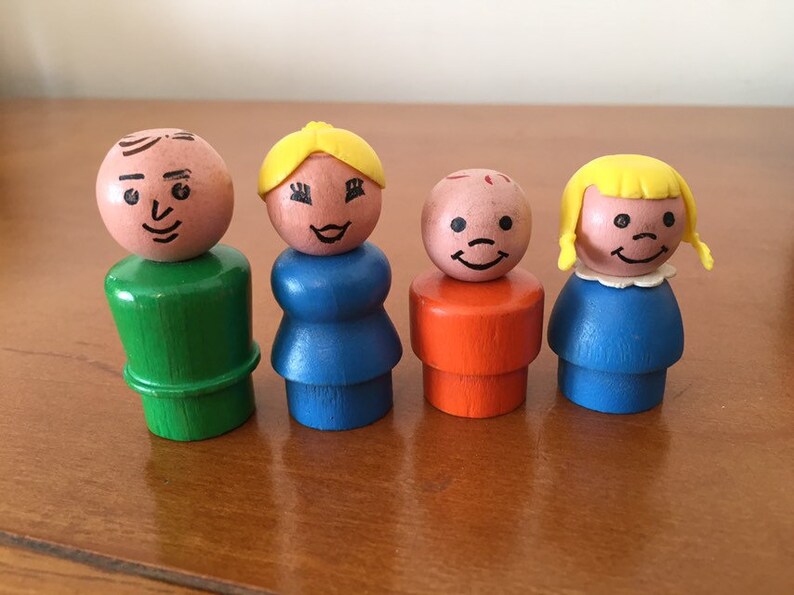
My favorite toys were my Fisher-Price Little People.


I have no idea why, but I decided, or was told, that their last name was "Smith" and so they became my "Smiffies." Looking at the picture now, I remember thinking that the mother was so beautiful.

When I was three or four, I decided that I wanted to be part of the Christmas gift-giving tradition, and so I carefully wrapped one of my Smiffies for each member of my family. The rest of them all found opportunities to slip their Smiffy back into my collection, but Mom kept the little orange boy on her dresser. After a while I asked if I could have it back and she explained no, it was a gift, and having given it away it didn't belong to me any more.


I spent hours playing with my Smiffies, both alone and with my friends, especially Lori. I had the house, but she had the airport, which was the coolest thing in the world. Later I would move on to Barbies and my sister's much-coveted Dawn Dolls, but I never loved them as deeply as the Smiffies.


One day I decided that I was going to walk over to Miss Norma's--she was the older lady in the church who served as our babysitter and adopted grandmother. I put my Smiffies in a bag--unfortunately, a paper one, and set off on the four block walk, a bold move of independence for me at five or six. Sadly, it was raining and as I crossed Main Street my bag broke, scattering my Smiffies across the road. The lady at the corner store saw me, frantically trying to rescue them, and came out to keep me from running into traffic in the gloomy late-afternoon darkness. When she understood my panic, she brought out a plastic bag and helped me to find as many as we could. Some were broken, others embedded with gravel. It's probably not true that I never played with them again after that, but something about that day broke my heart, made me realize that they were only pieces of wood, and the magic of the Smiffies was never quite the same again.
lillibet: (Default)
What was your Dad like when you were a child?

Dad was 47 years old when I was born, so in some ways he always seemed old to me. He and my mother had been married for almost twenty years at that point, and in the same job and home for ten years, so they were very settled in their lives. I was a complete surprise and threw a wrench into things in many ways, but he always let me know that he was delighted with me and wouldn’t have changed a thing.

My father was 6‘4” and seemed tall enough to touch the moon. When I was just six weeks old he fell on the ice and broke his arm—thankfully on the trip after he had carried me in from the car—so some of my earliest memories of him are “The Elephant Game,” which I only understood much later were the physical therapy exercises he did to restore strength and flexibility to that arm.

Dad was the minister and in our church, Sunday School came before church and once I was too old for the nursery I was expected to sit through the adult service next to my mother. I grew up listening to stories about myself from the pulpit and having him say “God Bless You,” in his beautiful bass voice when I sneezed in church.

He was very affectionate and much more emotionally open than my mother was. He would openly weep at romantic movies and loved for me to sit on his lap and snuggle with him. He could also get very angry at times—until I was an adolescent that was more directed at my sister than at me, but his loud voice made it seem that he was yelling even when he had no intention of doing so.

Like many families of the era, Dad was the “fun” parent, the one who took us for ice cream, or to McDonald’s, or out for a late movie on Thanksgiving night, while Mom set the chores and kept the rules and made us stop playing for dinner, or bedtime. I’m told that in earlier days he was perfectly able to cook for himself and Anne, but by the time I came along there was some combination of more money and learned helplessness, but he still took charge of the grill for backyard London Broil in the summertime.

Since we lived in the parsonage, just across the driveway from the church, he was around much more than many fathers. He worked in the mornings at his office in the church, came home for lunch, then spent the afternoon calling on parishioners who were sick, or going through other crises. When I was little he would take me along when calling on families with children, and by the time I was in junior high I would often go along with him once a week when he went up to the hospitals in Albany. On Sunday afternoons we would drive down to see my grandmother in the nursing home. Many of my best memories of him are of conversations we had in the car together.

He was never athletic and not much of a sports fan, though he always enjoyed watching the baseball game. He was a Rockefeller Republican, voting for Democrats in the presidential elections and trying to keep his more liberal leanings confined to the Christian life he lived largely for others. If he hadn’t felt a call to the ministry he would have been a history teacher and was a scholar of the Protestant Reformation and a big fan of historical fiction. He loved to read and happily encouraged me to read any book in his library that caught my eye. He tried hard to teach me the habit of reading a daily newspaper and though that never caught, he did make me see current events on a national and international scale as relevant to our lives and worthy of my attention.

Although I think I’m actually better than he was at telling stories, I learned it from him, the art of observing the world for the purpose of distilling its meaning and finding its lessons. He had a hard time letting go of the details and sticking to the point, and so I also learned from him the joy of digressions, of conversations that start on one topic and drift over the course of hours into far different regions. I still find myself wanting to tell him things and to hear how he would incorporate them into his Sunday sermon.
lillibet: (Default)
What were your grandparents like?

I didn’t get to have a long relationship with any of my grandparents—the first died when I was three and the last when I was twelve. What I know of them is largely from stories told by my parents and sisters and, more recently, from going through the family memorabilia and finding photos, letters, and other artifacts that flesh out their stories.

These were my mother’s parents: Murphy and Mitt. He was a carpenter who always resented being made to leave school at fourteen, a resentment that manifested in his proudly and whole-heartedly supporting my mother in her education. He was a very quiet man, loving and gentle. Mitt was more feisty, with a temper that made her relationship with my mother problematic, but also many fears and anxieties—she was so terrified of thunder that she would hide under the bed when a storm blew up. They worked hard all their lives, keeping their farm going and the family fed through the Great Depression. Mom was always proud of the Sunday dinners, where up to twenty folks would come around after church to eat with them, because “there was always food at Miss Mitt’s”.

A lot of what I remember of them isn’t about them, specifically, but about the farm in North Carolina. I don’t remember them ever visiting, though they did when I was very little. It was always us, driving south and south forever, until finally arriving at their place. I remember the smell of the sandy dirt after the rain, the strangely pleasant, rotting smell of the cold house where the freezer was, and the warm, dry smell of the old tobacco barns in the sunshine. I remember drinking cold Mountain Dew from a bottle, back when you couldn’t get it up north and it was the taste of summer. I remember picking corn and beans out of the fields and playing at the feet of the women shucking and shelling the vegetables for dinner. There was always work to do.

On the morning of her 50th anniversary, my grandmother had a major stroke. There was nothing to be done in those days—they got her dressed and put her in a chair at the reception while friends and family trooped by to pay their respects and she had no idea who any of them were. That was a horrifying time for my mother, but I remember Granny as one of the best playmates—we would play “pretend” and make believe that she didn’t know my name, or that she was a little girl like me, or that she didn’t know her way around the house she’d lived in for decades, and she was utterly convincing. She would give me slices of white bread with cold butter as a snack. In the morning, I would slip out of the bed I shared with my mother in the front room, sneak as quietly through my grandfather’s dark, shaded room as a three year old could, and out onto the back porch, where my grandmother slept in a tiny storeroom, almost filled by her big bed. I would open the door and shout “Boo, Granny!” and she would holler “Boo, ‘Lizbeth!” and I would jump on her bed and we would play while the rest of the household got up and ready for the day. One morning I shouted, but she didn’t respond, and my mother remembered being woken by my screams over Granny’s body.

I only have a few vivid memories of my grandfather, despite his having outlived my grandmother by two years. They may even all have been from the same trip, when I was five. Beckie was fourteen that year and somehow Dad got the idea of teaching her to drive on the dirt roads around the farm. She managed to put the car in one of the drainage ditches—she didn’t have much beginner’s luck. Dad tried various strategies to get the car back on the road and as he worked, shouting occasionally for Beckie to hit the gas, I kept jumping up and down and saying “Should I go get Poppo? Can I go get Poppo now?” Dad said “You sound like you don’t believe we can do this,” and I responded very seriously, “I don’t.” They both laughed and Beckie said “At least she’s honest!” Finally, finally Dad said “OK, Elizabeth, go!” I raced down the track to the barn where my grandfather was working and he fired up the tractor and let me ride along, holding onto the strap of his overalls as we chugged back to haul out the car.

On the long summer evenings the family would gather on the porch of the house that Poppo built, watching the occasional traffic pass by on the road. I was tearing around, probably being a pest, and Poppo told me to run around the house and he would time me. I ran and I ran and every time I came back to the big, broad steps, he would tell me my time and then say “Do it again. Run faster now,” and I’d be off again. When we drove away, I twisted around in the back seat to watch him wave to us as we pulled out of the drive and onto the highway for the long drive back to New York. A few hours after we arrived home, Uncle MG called to say that Poppo had died.


My father’s parents were very different. Raised in Kansas and Michigan, they married and moved to New York in 1919. My grandfather tried to establish himself in the financial world, but after the man from the next office jumped out the window in 1929, Grandfather decided it was time to get out of the business by a safer route. He spent the Depression taking an array of jobs—setting up distilleries in Canada, working on the Chicago World’s Fair—many of which kept him away from home for long stretches, leaving my grandmother to raise Dad alone, or with the company of her father, who lived with them for several years. She desperately wanted a girl, but miscarried many times after Dad was born—we now know that she was Rh negative, but in those days it was just a tragic mystery. She thought the moon rose and set on my father and would hear no criticism of him. They wrote to each other every week for more than twenty years—I have reams of her letters to him, filled with the details of her life, that reveal a surprisingly funny, money-fixated woman devoted to her husband and her church, but delighted to travel and find adventure.

She was a wonderful grandmother when my eldest sister was little. She would arrive by train with her suitcases stuffed with presents for her namesake and spend a week or more before Christmas baking cookies that filled the entire dining room table. She was a snappy dresser, with a certain elegance, and everyone was shocked when she threw herself down on the sled with Anne and played in the Michigan snow. She thought Anne was the most perfect child in the world and sent her cards and letters and treats throughout the year and begged in her letters for news of Anne’s health and latest accomplishments.

A year before I was born, Grandmother had her first major stroke. Throughout my childhood she spent stretches in the nursing home, returning to sit awkwardly in a green power lift chair. Her face was partially paralyzed by strokes and her gaze was glassy and unfocused. My parents would set me on her lap, where she would pluck at my clothing with long fingers, or they would tell me to hug her. She smelled medicinal and unsettling and her ability to talk changed as her brain tried to rearrange itself after each stroke. By the time I was five, she needed constant care and was placed in a nursing home about half an hour south of our home upstate. My grandfather couldn’t bear to see his “brown eyed Peg” so debilitated and never visited her there, but my father drove down every Sunday afternoon, despite the fact that she often had no idea who he was and would sob for her “Dickie boy,” and wonder why he didn’t come instead of this balding, middle-aged man she didn’t recognize. Visiting her was about equal parts scary and boring, but I always enjoyed the drive there and back with my dad. She passed away when I was eight.

My grandfather always seemed like a very stern, somewhat distant figure. He and my grandmother lived in a two bedroom apartment in Mount Vernon and when we visited my mother would make up the couch cushions on the living room floor as a bed for me. After his many jobs in the 30s he landed as the Executive Secretary of the International Merchant Tailors’ Association, where the main part of his duties was to organize their annual conferences in exotic locations like Miami or Chicago. He would also entertain visiting members from other countries and their breakfront—the same one that stands in my dining room today, was filled with gifts from around the world. The less-breakable ones were kept in the righthand door of that cabinet and I was allowed to pull out the sake cups and figurines and create elaborate games and fantasies around them.

If we were there on a weekday he would take me into the office on the train and I would spend the morning being given busy work—I remember using the porcelain stamp licker and drawing on scrap letterhead. His long-time secretary, Irma, was a very fashionable woman and she would take me out at lunch to Saks Fifth Avenue or Macy’s and buy me “a good dress,” just about the only clothing bought for me in those years of handmades and hand-me-downs. We would have sandwiches at one of the local lunch counters and bring one back to my grandfather and then my Dad and Beckie, usually, would pick me up and we’d go on an afternoon adventure somewhere in the city. On Saturdays my grandfather would swap his suit jacket for a cardigan, but I can’t picture him without a tie, even after he retired at eighty. It was shocking to find photos of him working the farms as a teen in Abilene, wearing nothing but overalls and a straw hat.

He could be a real curmudgeon—I think he never really knew how to interact with children except by teasing. The only time I’ve been stung by a bee was when he told me it was bothering a flower and I should squeeze it out of there. Another time, when I was five and we were out to an Italian restaurant, he was horrified to see me pick up the shrimp from my scampi by the tails to eat it and was loudly critical of my mother for failing to teach me to peel shrimp with a knife and fork. He never understood my father’s calling to the ministry and often criticized what he saw as an incomprehensible failure by my father to prioritize money in his life. When he died, at eighty-six, he left us much better off, financially, than we had been. At his funeral the minister kept referring to what a Brooklyn accent rendered as “Mistah Huntah,” so my last memory of my grandfather is of struggling not to giggle in a pew full of black-clad family.

And then I turned twelve and all my grandparents were gone.
lillibet: (Default)
Do you have any keepsakes or heirlooms from your father?

Goodness, so many! I have tried to pare down and get rid of most of my parents’ things, but it’s an ongoing process. I have documents and photos of my father’s entire life in surprising detail, even after three months of paring down all the letters, papers, photographs, etc. There are two belt buckles with Liberty dollars from the year Dad was born that seem, on the one hand, like I could easily let them go, but on the other hand like something that would have no meaning to almost anyone else and don’t have much value in themselves.

The one thing that I really take joy in is a nondescript gray sweater of my dad’s. It fits me pretty well and is super warm and comfortable, with a high neck, so it makes a great extra layer on very cold days. I always enjoyed snagging my dad’s clothes—more than my mom’s, which rarely fit me—and it’s nice to feel as though he’s still keeping me warm.

But the thing that I think of as my real treasure from my dad is not the material things that I can touch, or read, or look at. It’s the things that I learned from witnessing his work and talking with him through forty-two wonderful years. He taught me how to hold an interesting conversation, how to tell a story—which I’m actually much better at than he ever was—how to lead groups, how to be self-confident. He thought I was an amazing person—”How did you get so wise,” he once asked me—and that joy in my self is the enduring legacy that I hold.One of my therapists once said that no matter how far down she drilled, there was always a sense of self-worth, a knowledge that I am loved and worthy of love. If you asked me about my father’s flaws I could go on at least this long, but his gift to me was that enduring belief that someone has always loved me. That’s my dad.
lillibet: (Default)
What stories have you been told about yourself as a baby?

I think that it’s because my sisters were old enough to remember things that happened while I was a baby and to be part of they “hey, remember when E…” conversations, my babyhood comes up in conversation pretty frequently.

I’m planning to leave this post open and add to it as I remember different stories I have been told. Maybe Beckie or Anne will chime in with additions.


- holding up my head and focusing much earlier than expected

- first word “baby,” second word “Becca,” my sister

- calling myself Ebus, much to Mom’s puzzlement

- baby words: cugar, oo-oops, i-kippies

- calling Leo “Leelow”

- freaking people out by talking so early

- kicking on the wall to make Beckie take me into bed with her

- eating bologna wrapped around gherkins and the cat nibbling the bologna out of my fingers
lillibet: (Default)
What is the best meal you've ever had?

I have had a lot of wonderful meals and several spectacular ones and have cooked a few showstoppers, though I have the advantage of being able to make food exactly to my own taste. I’m not sure anything will ever equal the taste of my mother’s fried chicken with rice and gravy and there are few things as perfect in this world as a really good grilled cheese sandwich and there are times that I would pay any money for Mary’s suan la chow show or the duck with winter greens from Y Ming. I love to eat and to dine—different things, both beautiful—and it’s really all about the moment.

But one of the most special meals I’ve enjoyed was at Guy Savoy Paris, on Jason’s 29th birthday. Here’s how I described it at the time:

Located on a side street north of the Arc de Triomphe (though it has since moved) Guy Savoy is an easy place to miss, with its sliding door looking like a wall of wood and glass. Inside is a secluded, modern dining room with lots of wood and metal. While lovely, it felt somewhat sterile to me, like the executive dining room of a very high end law firm.

The meal that followed was just incredible, characterized by bold combinations of flavors used to create remarkably subtle overall effects. We began with a glass of champagne. First we were handed an amuse bouche of a small crostini with a slice of duck liver pate. That was followed by a bite of a watermelon and radish confection. Then we were brought a plate with one bite each of a lovely marinated and grilled tuna, a skewer of tomato and squid, and a tiny bowl of carrot soup with star anise. Neither of us generally enjoy anise, but the flavors combined so perfectly that we were both quite impressed.

Somewhere amid all this showing off by the chef, we got to order. We declined the E170 tasting menu and went a la carte instead. Jason ordered the grilled mussels with morel mushrooms in a light butter sauce and I asked for the house specialty of cream of artichoke soup with shaved black truffles and parmesan cheese with a mushroom-stuffed brioche with truffle butter on the side. We were therefore surprised when our waiter brought two portions of the mussels. I explained the mistake and he apologized, left the mussels with us and brought us each a half portion of the soup as our next course.

With our first courses, we were enjoying the sommelier’s recommendation of a half bottle of Meursault, a white varietal unfamiliar to us, but destined to become quite a favorite. With our mains, we split another half bottle, this one of Bordeaux. I was starting to write down the names when the sommelier offered us the labels, which he brought us in a Guy Savoy souvenir folder that we will add to our memorabilia to remind us of a fabulous gustatory experience.

For mains, Jason had a lovely roast lamb, carved tableside, over greens with tiny hunks of bacon, with a cheesy spinach and mushroom side dish. Mine was pigeon, poached to keep in the juices and then grilled to crisp the skin, served with pureed peas and spinach and drizzled with a sherry vinaigrette. On the side I was brought the pigeon gizzards in a napoleon (layers) of beet chips.

After those were cleared away and we declined the cheese course, they brought us a plate of petit fours, including a sliver of chocolate with a square of gelatin topped with currant, a berry meringue filled with berry mousse, a vanilla pastry shell filled with something creamy, and a candied fruit (one of those things that looks like a tomatillo, but is sweet—or so other people tell me; I find them so sour they send shivers down my spine, although that reaction was mitigated by the caramelized sugar coating this one), each one bite-sized. They also handed us a small caramel crisp encrusted with macadamia nuts and pink praline. For dessert (no, that wasn’t dessert, apparently) we split a millefeuille, layers of puff pastry filled with a vanilla cream, with just a few strawberries, currants and raspberries on the side. We declined coffee, protested that we were really quite finished and asked for the check. Before we could have that, they brought us two more small bites (which our waiter very sternly told us would help our digestion), one of Earl Grey sorbet (which was a revelation to Jason—he was close to tears) and a tiny sliver of apple tart. Whether it was those, or just the impeccable balance of the meal, we were both surprised to find ourselves only pleasantly full, not bloated at all.
________________

It is funny and a little humbling to me now how very little we understood about this level of dining, the gauche mistakes we made, and the opportunities lost. But the staff were very kind to us and we have learned so much since then, but that meal still stands out. A few years ago we were excited to try Guy Savoy’s new establishment in Las Vegas and terribly disappointed by the experience. Perhaps we will return to Paris one of these days…
lillibet: (Default)
What is the most awkward date you've been on?

Back in the dark ages of the Internet, I hung out a bunch on USENET. I'm not sure where I ran into The Captain, but we had a pleasant conversation and agreed that we would meet in Downtown Boston and hang out for a couple of hours. So I'm standing on a corner, looking around for someone who fits the description this guy gave me, when a tan Trans Am convertible pulls up next to me with a deeply unattractive guy at the wheel who says "Elizabeth?" It's him.

I've forgotten what his real name was, because one of the first things he said when I got in the car, back in those more innocent days when that seemed like a reasonable thing to do, was that all his friends call him "The Captain," like Captain Kirk. He's a big Star Trek fan--this is fine, I like Star Trek myself. No, no, I don't understand, he's a BIG Star Trek fan. He's been thinking about moving out of his mother's basement, but most of his disposable income goes to expanding his collection of Star Trek memorabilia, which has been appraised at over $1500. Besides, if he moved, he'd be concerned about things getting broken and security for his valued figurines, some of which are worth more than $50 each.

He asks what I'd like to do and after rejecting a couple of suggestions--he doesn't like art, can't really go for a walk thanks to his knee injury, doesn't drink coffee, and isn't hungry right now--decides that he's going to give me a tour of "his Boston". We drive around Allston, where he grew up, and see the Catholic elementary school he attended, and the house where his mother raised him. The kitchen window looked out over the school playground, so when his mom caught him beating up on smaller kids, she'd come sailing out with a wooden spoon and whup his ass.

No, he didn't go to college. He's got a data entry job that he can do via a remote terminal. It pays really well, and he can just have a couple of machines at his mom's. The main office was in Cambridge, but they're talking about moving to California. I mention that I'm thinking about moving to California and he says maybe he'll drive out there one of these days and visit me. He doesn't like to fly, well, he wouldn't know as he's never actually flown, but he really loves to drive long distances. What do I say to driving out along the beach? I try to say that this is getting longer than I was really expecting and he says nah, it'll be quick, and drives me out to the coast.

So, he asks, what do I think of the car? I say that it's very nice. He explains that it's not why he has it, not to impress "the chicks". He doesn't really care what other people think, although most chicks do seem to have a thing for Trans Ams. That's why he was late to meet me, he explains, he was having it waxed and there were a couple of chicks at the carwash who were really into the car. They wanted a ride in it, he could tell, and he hated to disappoint them, but he told them he had a date to get to. They said he should bail on his date and take them for a ride instead, but The Captain is a man of his word. Anyway, all that conversation about the car slowed him down and that's why he was a few minutes late. Just so I know, he isn't usually late.

We drive along--it was a gorgeous day and the views were really lovely. He told me all about his Star Trek gaming group and what he's looking for in a girlfriend. I ask if he's ever been to one of the local science-fiction fan conventions and he says no, that he went to a Star Trek convention once, got something signed by George Takei--do I know who that is? But he just wasn't interested in all those people, everyone posing, trying to prove what a big Star Trek fan they are. The Captain doesn't care if you have only a small collection, or if you focus on autographs, or if you just like to watch the show, although he's not sure that anyone who just watches Star Trek on TV could really be considered a fan, y'know? But who is he to judge?

As we pull up in front of my house, The Captain tells me that this is the greatest date he's ever been on. He feels like he can really talk to me, like a guy, y'know? That's it, I'm not like other women, I can have a real conversation. I'm just too cool. He's got to see me again, because I am just too cool. Maybe he'll call me and I could come over and see some of his collection. He doesn't usually let chicks around his collection, but he can tell I'm really different. I'm just too cool.

I thank him for the ride, make a noncommittal remark about being pretty busy in the next few weeks, and dive for the shelter of my building, thinking that he's absolutely right. I am, indeed, too cool to spend another minute of my life with The Captain.
lillibet: (Default)
Did you ever get lost as a child?

I can't recall that I ever got lost, in the sense of not knowing where I was, but my parents frequently lost me. At the mall they would sit me down in the children's section of the bookstore while they did their other errands and I would read happily until they came back. At least once that was after getting in the car to head home and realizing they'd forgotten something! We would get separated in crowds and they'd panic at not being able to find me, but I usually had just gotten distracted and was back along their path. My dad used to say that since he was generally the tallest person in a crowd, I should easily be able to see him and keep up with him, but it also meant he had the longest legs!

One of my favorite times of being "lost" was at the Washington Monument. We'd had a long day of touristing and then spent far longer than I had the attention span for touring the exhibit at the top. It was time for our group to descend, so we all got into the elevator and I scooted to the back and sat down on the floor. Mom got on, saw Beckie and said "Do you have Elizabeth?" I said "I'm here," but no one heard me. Beckie said no, so Mom asked Dad. I said "I'm here." Dad said no, and asked Beckie, who said no, and I hollered "I"m here! I'm at the back!" The doors closed and the attendant asked if anyone had any questions. One smart alec said "Only one! Who's Elizabeth?" and everyone laughed.

Profile

lillibet: (Default)
lillibet

September 2021

S M T W T F S
   1234
567891011
12131415161718
19 202122232425
2627282930  

Syndicate

RSS Atom

Most Popular Tags

Style Credit

Expand Cut Tags

No cut tags
Page generated Jun. 25th, 2026 09:00 pm
Powered by Dreamwidth Studios